

Concrete waste varies from clean broken slabs to reinforced concrete and mixed demolition debris. Choosing the wrong crushing configuration can cause blockages, excessive wear, or inconsistent output. Before buying a mobile concrete crusher, you need to evaluate the material, maximum feed size, required discharge size, and expected production rate.
YG Machinery offers crushing equipment in different size and capacity ranges. The right model depends on your site conditions and recycling goals. This guide explains which materials are suitable, what configuration each application may require, and how to use equipment specifications to make a better purchasing decision.
Technical Data of Mobile Concrete Crusher
| Model | Feeding Size | Discharging Opening Size | Capacity | Power | Weight | Overall Dimension |
| (mm) | (mm) | (t/h) | (kw) | (t) | (mm) | |
| YG250×400 | ≤210 | 20-60 | 5-21 | 15 | 2.8 | 1300*1090*1270 |
| YG400×600 | ≤340 | 40-100 | 16-64 | 30 | 7 | 1730*1730*1630 |
| YG500×750 | ≤425 | 50-100 | 40-110 | 55 | 12 | 1980*2080*1870 |
| YG600×900 | ≤500 | 65-160 | 50-160 | 55 | 17 | 2190*2206*2300 |
| YG750×1060 | ≤630 | 80-140 | 110-320 | 110 | 29 | 2660*2430*2800 |
| YG900×1200 | ≤750 | 95-165 | 220-380 | 132 | 52 | 3380*2870*3330 |
| YG1000x1200 | ≤850 | 195-265 | 315-500 | 160 | 55 | 3480*2876*3330 |
| YG1200×1500 | ≤1020 | 150-350 | 400-800 | 160-220 | 100.9 | 4200*3300*3500 |
| YG1500×1800 | ≤1200 | 220-350 | 500-1000 | 280-355 | 139 | 5160*3660*4248 |
| YGX150×750 | ≤120 | 18-48 | 8-25 | 15 | 3.8 | 1200*1530*1060 |
| YGX250×750 | ≤210 | 25-60 | 13-35 | 22 | 5.5 | 1380*1750*1540 |
| YGX250×1000 | ≤210 | 25-60 | 16-52 | 30 | 7 | 1560*1950*1390 |
| YGX250×1200 | ≤210 | 25-60 | 20-60 | 37 | 9.7 | 2140*1660*1500 |
| YGX300×1300 | ≤250 | 20-90 | 16-105 | 55 | 15.6 | 2720*1950*1600 |
| YGX500×1500 | ≤3250 | 25-120 | 50-160 | 90 | 20 | 2360*2660*2105 |
| Model | 800×800 | 800×1000 | 1000×1200 | 1200×1200 | 1200×1500 | 1400×1600 |
| Motor Power | 90kw×4G | 110kw×4G | 132kw×4G | 160kw×4G | 185kw×4G | 250kw×4G |
| Diesel Power | 195HP | 195HP | 260HP | 330HP | 330HP | 400HP |
| Hopper | 3500*1800*8mm | 3600*2200*8mm | 3600*2200*8mm | 3800*2200*8mm | 3800*2200*8mm | 4000*2400*10mm |
| Hammerhead Weight | 15kg | 15kg | 20kg | 36kg | 36kg | 55kg |
| Total Weight | 10t | 12.5t | 14t | 19t | 21t | 26t |
| Belt | 7×0.8m | 8×0.8m | 8×1m | 8×1m | 8×1m | 9×1m |
| Belt Conveyor Power | 5.5kw | 5.5kw | 7.5kw | 7.5kw | 7.5kw | 7.5kw |
| Tyre Model×Number | 1100×8pcs | 1100×8pcs | 1100×8pcs | 1000×12pcs | 1100×12pcs | 1100×12pcs |
| Sand Capacity | 30t | 45t | 55t | 65t | 80t | 100t |
| Stone Capacity | 50t | 70t | 80t | 90t | 120t | 180t |
| Overall Size | 10*2.8*3.5m | 11*2.8*3.5m | 11.5*2.8*3.5m | 12*3*3.6m | 12*3*3.6m | 13*3.2*3.7m |
Can a Mobile Concrete Crusher Process Clean Concrete Blocks?
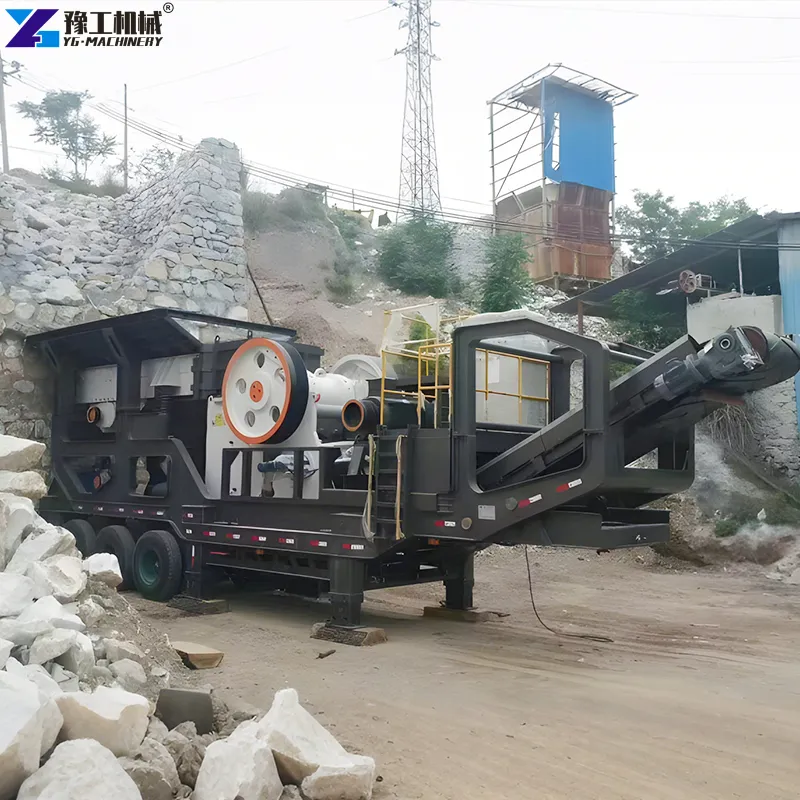
Material / Condition: Broken concrete blocks, demolished slabs, and relatively clean concrete rubble.
Recommended? Suitable
Why: Clean concrete is generally suitable for primary crushing when the feed size falls within the machine’s rated limits. On-site processing can reduce waste transportation and produce recycled aggregate for approved construction applications.
For example, YG’s YG400×600 model has a maximum feed size of 340 mm, a discharge opening range of 40–100 mm, and a stated capacity of 16–64 t/h. The YG600×900 accepts feed up to 500 mm, with a stated capacity of 50–160 t/h.
Required Configuration:
- A crusher matched to the largest concrete pieces.
- Loading equipment that feeds material consistently.
- A suitable discharge conveyor.
- Optional screening when different aggregate sizes are required.
Important Limitation: The discharge opening does not guarantee that every particle will have the same size. Actual output depends on material properties, feed consistency, machine settings, and operating conditions.
Can Mobile Concrete Crusher Reinforced Concrete?
Material / Condition: Concrete containing embedded steel reinforcement, wire, or metal bars.
Recommended? Suitable with the right configuration
Why: Reinforced concrete can often be crushed, but steel introduces additional handling risks. Long bars may obstruct material flow, wrap around moving components, or remain mixed with the crushed aggregate.
The crushing equipment must match both the concrete dimensions and the reinforcement conditions. Pre-cutting, pre-breaking, or downstream metal separation may be necessary.
Required Configuration:
- A crusher suitable for the concrete’s size and strength.
- Pre-processing for oversized reinforced sections.
- A plan for removing exposed reinforcement.
- Metal separation equipment when the required product quality demands it.
Important Limitation: The YG model specifications provided do not establish a universal steel-handling capability. Confirm acceptable reinforcement dimensions and operating procedures with the supplier before ordering.
Is It Suitable for Large Concrete Slabs?

Material / Condition: Thick floor slabs, large structural sections, and oversized demolition blocks.
Recommended? Suitable with the right configuration
Why: A machine’s feed opening can limit production even when its nominal capacity appears sufficient. Concrete pieces that exceed the maximum feed size must be reduced before entering the crusher.
Required Configuration:
- A crusher with a suitable feed opening.
- Hydraulic breaking or other pre-breaking equipment when needed.
- Loading equipment matched to the prepared material.
- Adequate space for safe loading and material movement.
Important Limitation: Do not select equipment by capacity alone. Check the actual dimensions and shape of the largest blocks. The YG1000×1200 model also has a wider listed discharge opening than the smaller models, so confirm that its output range meets your project requirements.
Can Mobile Concrete Crusher Process Mixed Construction and Demolition Waste?
Material / Condition: Concrete mixed with bricks, masonry, mortar, tiles, and other demolition debris.
Recommended? Suitable with the right configuration
Why: Mixed demolition waste varies in hardness, moisture, and contamination. Some materials can be processed together, while others require sorting before crushing.
A suitable mobile concrete crushing plant may combine pre-sorting, primary crushing, screening, and separate material handling. The configuration should reflect the dominant material and the required quality of the recovered aggregate.
Required Configuration:
- Pre-sorting to remove unsuitable materials.
- A crusher matched to the main feed material.
- Screening for the required output sizes.
- Additional separation equipment where necessary.
Important Limitation: Wood, plastic, insulation, gypsum, and excessive soil can reduce product quality or interfere with processing. Identify hazardous materials before handling demolition waste. Do not assume that mixed debris will produce clean recycled concrete aggregate without additional treatment.
What About Wet or Soil-Contaminated Concrete?

Material / Condition: Concrete mixed with wet soil, sediment, or sticky fine material.
Recommended? Suitable with the right configuration
Why: Moisture and contamination can affect feeding, screening, and discharge. Sticky fines may accumulate on equipment surfaces, while soil can reduce the quality of recovered aggregate.
Required Configuration:
- Inspection and sorting before crushing.
- Feed and discharge arrangements suited to the material.
- Screening selected for the moisture conditions.
- A maintenance plan based on material abrasiveness and operating hours.
Important Limitation: Saturated, sticky material may cause serious flow and screening problems. Where contamination is excessive, pre-cleaning or separation may be more effective than direct feeding.
Quick Material Compatibility Guide
| Material or Condition | Recommendation | Main Check |
|---|---|---|
| Clean concrete blocks | Suitable | Maximum feed size and target output |
| Reinforced concrete | Suitable with the right configuration | Steel handling and separation |
| Large concrete slabs | Suitable with the right configuration | Pre-breaking and feed opening |
| Mixed demolition waste | Suitable with the right configuration | Sorting and contamination |
| Wet, soil-contaminated concrete | Suitable with the right configuration | Moisture and screening |
| Unsorted hazardous waste | Not recommended | Identify and remove hazardous materials first |
How Do You Choose the Right YG Crusher Model?
Start with the maximum feed size, required discharge opening, and expected hourly output. For example, the YG250×400 has a stated capacity of 5–21 t/h and accepts feed up to 210 mm. The YG900×1200 accepts feed up to 750 mm and has a stated capacity of 220–380 t/h.
These figures are preliminary selection references, not guaranteed concrete-processing results. Actual capacity depends on the feed material, operating settings, and complete system configuration.
An impact crusher may also be worth evaluating when the project requires a different crushing approach or aggregate shape. Compare the material characteristics, wear costs, and desired output before choosing a machine type.
For larger projects, a mobile crusher plant may need conveyors, screening equipment, and suitable loading machinery. Confirm the complete production line rather than comparing individual crusher capacities alone.
Request a Configuration for Your Concrete Waste
YG Machinery can help assess your project requirements. Send us photos of the material, maximum block dimensions, reinforcement details, target discharge size, and estimated hourly capacity.
Our team can use this information to identify suitable equipment options and prepare a quotation for your application.
Contact YG Machinery to discuss your concrete recycling project and request a suitable crushing configuration.