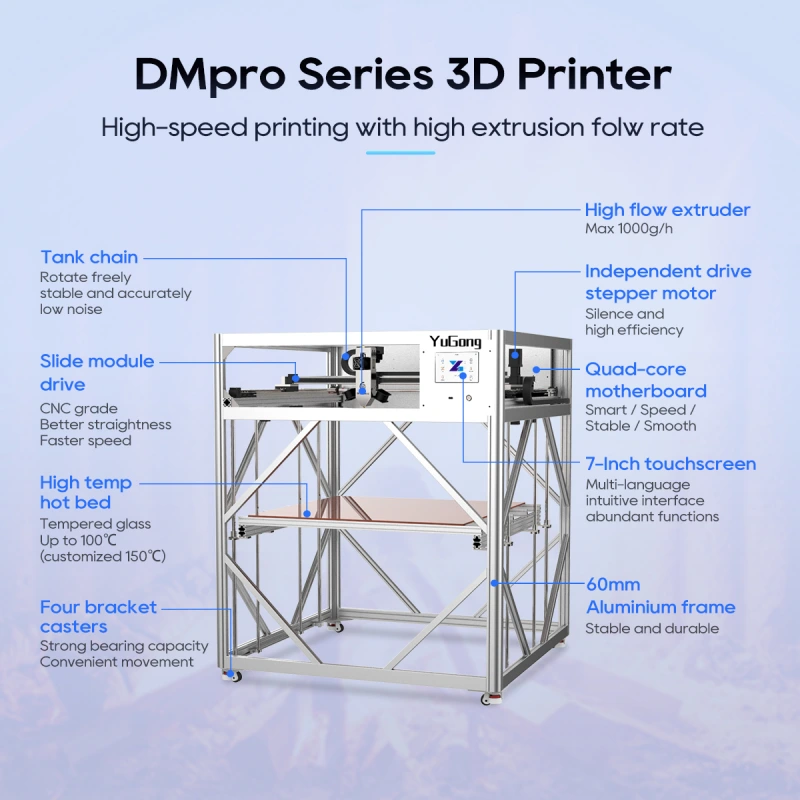
Precision has become a key standard in industrial printing. According to SmarTech Analysis, more than 68% of industrial buyers care more about print accuracy than print speed. The trend is clear. Many competitor websites focus only on large build size or fast printing. Real factories care more about dimensional stability, repeatability, and detailed surface quality. That is where a high precision 3d printer becomes important.
During the past three years, we spoke with many European factory buyers. Most said the same thing: fast printing means nothing if dimensions change. Simple reality.
High Precision 3D Printer Parameter
| Model | YG-DMpro | YG-DL |
| Printing speed | 150-500mm/s | 150-500mm/s |
| Nozzle diameter | 0.8mm/1.2mm/1.6mm/Customizable | 0.8mm/1.2mm/1.6mm/Customizable |
| Control panel | 10-inch color capacitive touchscreen | 10-inch color capacitive touchscreen |
| Nozzle temperature | 0-350℃ | 0-350℃ |
| heated bed temperature | 0-100℃ | 0-100℃ |
| Constant temperature heating | 0-60℃ | 0-60℃ |
| File types | STL/STP/STEP/OBJ/GCODE/JPG, etc. | STL/STP/STEP/OBJ/GCODE/JPG, etc. |
| Consumable specifications | 2.85mm universal consumables | 2.85mm universal consumables |
| Consumable types | PLA/ABS/ASA/PETG/PVA/TPU, etc. | PLA/ABS/ASA/PETG/PVA/TPU, etc. |
| Positioning accuracy | 0.002mm | 0.002mm |
| Connection method | WIFI connection / offline printing via USB flash drive | WIFI connection / offline printing via USB flash drive |
| Input power | 110v/220v | 110v/220v |
| Optional features | 60°C constant temperature enclosure / 150°C high temperature platform | constant temperature enclosure / 150°C high temperature platform |
Why Is A High Precision 3D Printer Better For Manufacturing?
1. Lower Printing Error
A high precision 3d printer can usually keep layer accuracy within 0.1mm. This matters for industrial assembly.
Many mechanical parts need repeated testing. If dimensions shift too much, assembly fails. In industrial fdm 3d printer applications, stable motion systems matter more than extreme speed.
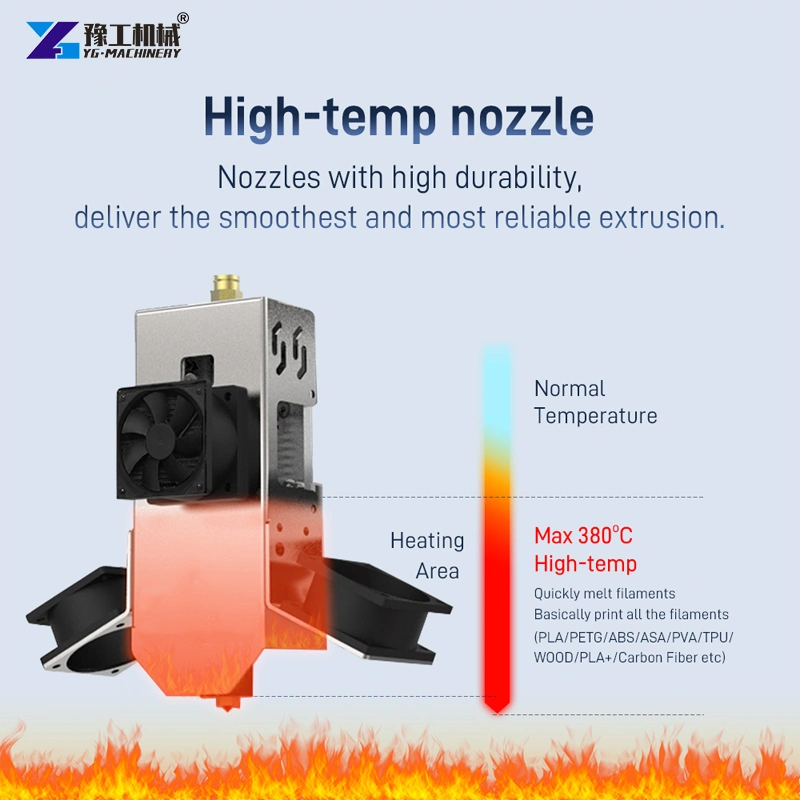
YG Machinery uses a rigid frame and dual rail structure. Movement stays stable during printing. Details become cleaner.
2. Better Long-Time Printing Stability
Many standard machines develop layer shifting after ten hours. Industrial users cannot accept that. We noticed many competitors never share long-hour printing test data. True industrial machines need stable performance verification.
Before shipment, YG Machinery runs 72-hour continuous printing tests. These tests check:
- Rail stability
- Heated bed consistency
- Nozzle blockage risk
- Long-print layer consistency
This step matters a lot.
3. Dual Extruder Design Improves Complex Printing
A dual extruder 3d printer works better for difficult structures. Especially for medical and industrial models. Dual extruders support soluble support materials and multi-material printing. Complex overhangs become easier.
Post-processing time becomes shorter. Many buyers only understand this after real production use.
Where Is High Precision 3D Printer Technology Used?
Healthcare Industry
healthcare 3d printing requires strong accuracy. Hospitals often print:
- Surgical planning models
- Custom rehabilitation tools
- Dental models
- Medical education parts
An Italian customer named Luca once told us they outsourced medical models before. Every modification required extra waiting time. Later, they started using our high precision 3d printer. Model production time dropped by around 65%. Doctor communication improved.
Industrial Manufacturing
industrial fdm 3d printer systems are widely used for:
- Functional prototypes
- Assembly fixtures
- Structural testing
- Small-batch production
Many factories now reduce CNC sample production. 3D printing changes designs faster. Cost also drops.
Education And Research
Many universities now build precision printing labs. Students need more than simple models. They need dimensional validation. Research teams focus on rapid iteration. They do not want long supplier lead times.
Why Do Some High Precision 3D Printer Systems Fail To Deliver Accuracy?
This is a real concern for buyers. In reality, print precision depends on more than nozzle size.
Real printing quality depends on:
- Frame rigidity
- Rail stability
- Temperature control
- Extrusion consistency
- Slicing optimization
If the structure moves during printing, layer lines become inconsistent. This is why many low-cost systems struggle in industrial work.
💡 Tip: Real precision comes from the whole machine structure.
Customer Case: How A UK Buyer Improved Product Development Speed
In 2025, we worked with a UK industrial designer named Daniel. He develops automation equipment housings. Before using our system, prototypes depended on external suppliers. Each modification required seven to ten days. Later, they purchased a YG Machinery high precision 3d printer.
The results were clear:
- Product validation time dropped by 58%
- Prototype cost decreased by around 70%
- Engineering modifications became faster
- Small-batch testing improved
Daniel later added a second machine. His R&D team now depends on fast iteration.
How To Choose The Right High Precision 3D Printer?
Industrial users should focus on these factors:
Check Continuous Printing Ability
Industrial production often requires long-hour printing.
Check Machine Structure
Dual rails and rigid frames improve stability.
Check Material Compatibility
Open material systems give more flexibility later.
Check Software Compatibility
Support for Cura and Simplify3D makes the operation easier.
High Precision 3D Printer FAQ
Most systems can reach 0.1mm accuracy or better.
It supports complex structures and reduces post-processing time.
Yes. It works well for functional testing and short-run manufacturing.
PLA, PETG, and some biocompatible materials are common.
A high precision 3d printer is no longer only a design tool. It now helps industrial manufacturing, healthcare, and research teams reduce errors, shorten development cycles, and improve testing efficiency.
For real industrial users, stability, continuous printing performance, and overall machine structure matter more than print speed alone.
YG Machinery continues providing reliable industrial 3D printing solutions for global customers.