

In construction machinery, the performance of a concrete boom pump truck is not defined by boom length alone.
Many Google competitors only list specs like 37m or 56m.
But they ignore the real key: system matching between hydraulic pressure and concrete behavior.
That is where efficiency and clogging problems come from.
Tip: Boom length is not everything. Pressure curve matters more.
Concrete Boom Pump Truck Parameters
| Specification | Unit | Value |
| Dimensions (L×W×H) | mm | 5600×2280×3200 |
| Machine weight | t | 12 |
| Total working weight | t | 18 |
| Engine power | kW | 91 |
| Emission standard | — | National II |
| Max theoretical pumping output | m³/h | 50 |
| Travel mode | — | All-terrain crawler |
| Max travel speed | km/h | 5 |
| Mixing volume per batch | m³ | 2 |
| Max boom placing height | m | 15 |
| Horizontal placing length | m | 11.8 |
| Track size | mm | 450×90×82 |
Why Concrete Boom Pump Truck Performance Differs So Much?
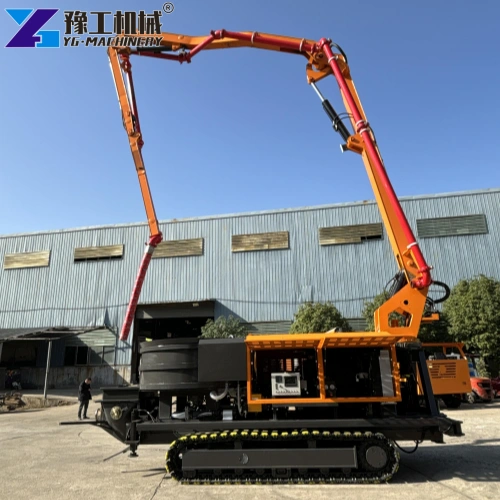
The answer is simple. System matching defines output. Field tests show up to 40% efficiency gap between similar units.
Key factors include:
- Hydraulic response speed
- S-valve switching stability
- Concrete slump range
- Pipeline resistance control
Long technical sentence:
The main hydraulic pump adjusts variable pressure output while dual cylinders push concrete alternately and the S-valve switches within 0.3 seconds to maintain continuous flow.
Short version: no blockage.
Hydraulic System of Concrete Boom Pump Truck
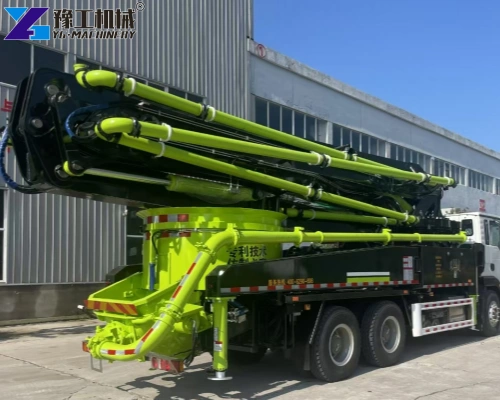
Pressure and Flow Balance
Typical working range:
- 32–42 MPa pressure
- 120–180 m³/h flow
Higher pressure is not always better.
Mismatch increases wear.
Tip: Pressure and pipe diameter must match.
S-Valve Stability System
The S-valve is the switching core.
Common issues:
- Uneven wear
- Switching delay
- Backflow
YG design improves:
- Wear-resistant alloy coating
- Smooth flow channel
- Lower switching impact
Concrete Boom Pump Truck vs Other Pump Types
VS Concrete Line Pump Truck
A concrete line pump truck is flexible.
But it has limits:
- Higher friction loss
- Limited distance
- Frequent pipe setup
A concrete boom pump truck:
- Direct placement
- Less pipe loss
- 30% higher high-rise efficiency
VS Crawler Concrete Pump
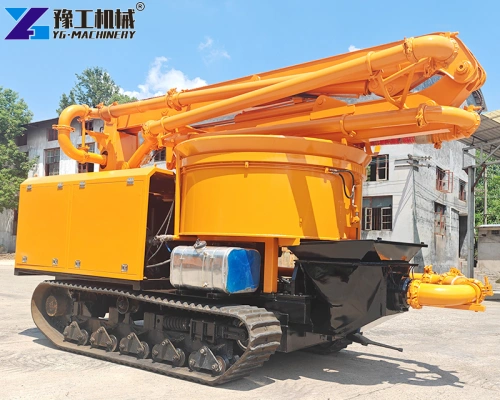
A crawler concrete pump is strong on rough terrain.
But:
- Slower relocation
- Not ideal for cities
- Lower transfer efficiency
Clear rule:
- Urban high-rise → boom pump
- Mountain site → crawler pump
Multi-Industry Applications
High-Rise Buildings
On 40-floor projects:
- 28% efficiency increase
- 15% labor reduction
Key point: continuous pumping stability.
Bridges and Foundations
Needs:
- Long distance pumping
- High drop delivery
Requires:
- High pressure system
- Wear-resistant pipes
Tunnel Projects
Limits:
- Narrow space
- Difficult maintenance
Needs:
- Compact boom design
- Low vibration system
Overseas Case Study (Spain)
A contractor used YG concrete boom pump truck in metro construction.
Problems:
- Frequent clogging
- Low night efficiency
Upgrades:
- Optimized S-valve flow
- High wear-resistant pipes
- Adjusted pressure curve
Results:
- 60% fewer blockages
- 32% higher efficiency
- 50% less maintenance time
Customer said: “Now the machine works with us, not against us.”
YG Machinery Technical Summary
In real projects, concrete boom pump truck performance depends on system engineering, not brochure numbers.
YG focuses on:
- Hydraulic stability
- Pressure control logic
- Multi-condition adaptation
- Real site optimization
In today’s market, machines must work on site, not on paper.